How We Integrated Claude into a SaaS Support Workflow (45% Cost Cut)
A walkthrough of how we embedded Claude into a SaaS support pipeline — triage, drafting, auto-resolution — and cut cost per request by 45%.
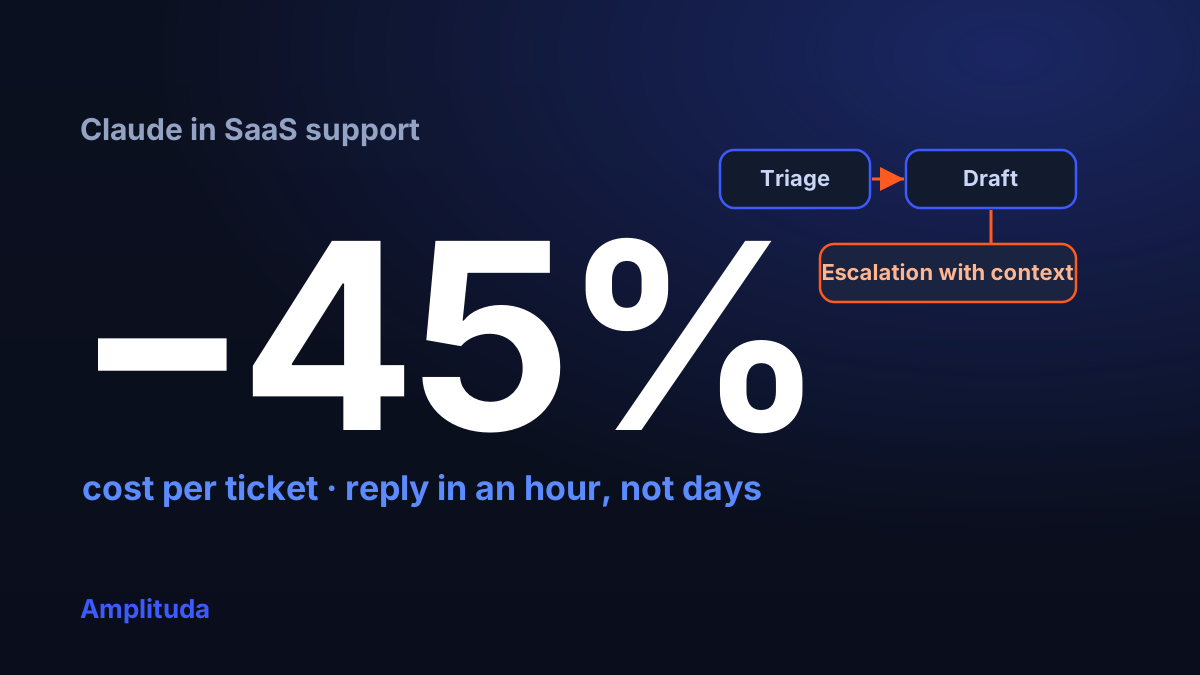
A SaaS support queue is a cost machine. Every ticket needs a human to read it, understand it, find the answer and reply — and most of those answers are variations on a handful of known questions. We embedded Claude into one client's support workflow and cut the cost per request by 45%. Here is how the pipeline actually works.
The starting point
The client's support team handled a steady flow of tickets through a shared inbox. Roughly 70% of those tickets were repetitive: password resets, billing questions, "how do I do X" requests already covered in the docs. Each one still took an agent's full attention, and at peak times the first-reply time stretched to days.
The goal was not to remove humans — it was to stop spending human attention on answers a machine already knows.
How the workflow is built
We built the pipeline on n8n with Claude doing the language work. A ticket flows through three stages.
Stage 1 — triage
When a ticket arrives, Claude classifies it: category, urgency, and whether it is a known repetitive question or something that needs a human. This replaces the manual sorting that used to eat the first chunk of every agent's shift.
Stage 2 — drafting and auto-resolution
For known questions, Claude drafts a full reply grounded in the knowledge base. Simple, high-confidence cases are resolved automatically; everything else is handed to an agent with the draft and context already prepared. The agent edits and sends instead of writing from scratch.
Stage 3 — escalation with context
Genuinely complex tickets go straight to a human — but never cold. Claude attaches a summary, the relevant account details and what it already tried, so the agent starts solving instead of investigating.
Where the 45% came from
The saving is not from a single trick. Auto-resolution removed a slice of tickets entirely. Drafting cut handling time on the rest. Triage eliminated manual sorting. Add them up against the cost of an agent-hour, and the cost per request dropped 45% — while first-reply time fell from days to under an hour.
Crucially, quality did not drop. Because humans still review everything that is not trivially safe, the AI never sends a wrong answer unchecked. The model handles volume; people handle judgement.
Want this for your support
If your support queue is full of repetitive tickets, there is a real saving sitting in it. Tell us about your workflow and we will estimate the cost cut on your own numbers. More on the approach in our automation services.